
|
|
| | Book | | | ✉ Contact | | | +212 600 608 608 |
 Français
  English
  Español
  Italiano
  Deutsch
  Nederlands
  Português
  Polski
  Norsk
Norsk  Svenska
  Dansk
Dansk 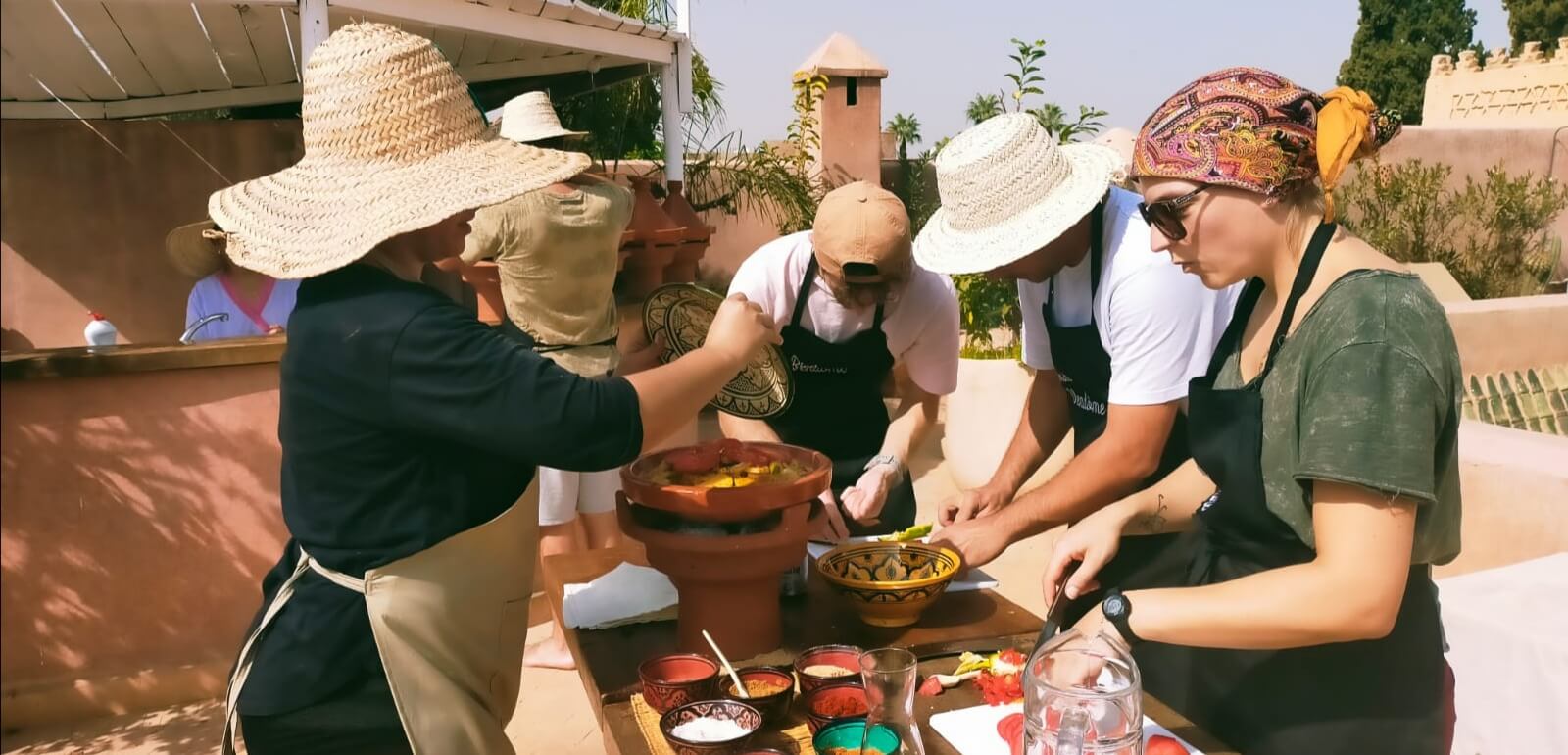
Moroccan Cooking Class for All Diets: Vegan, Gluten-Free, Halal & More
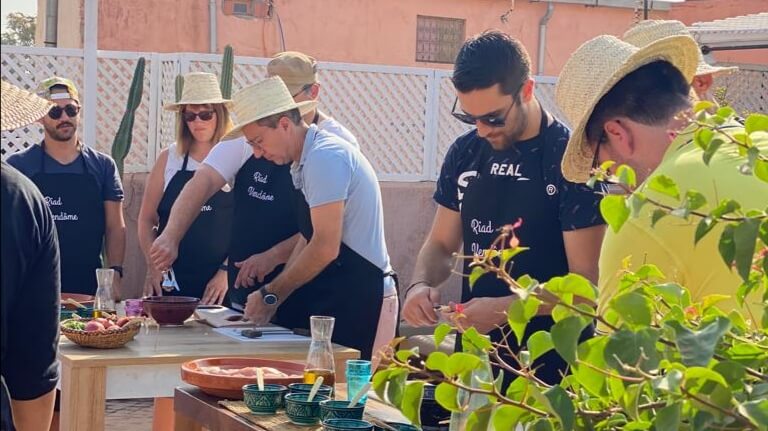
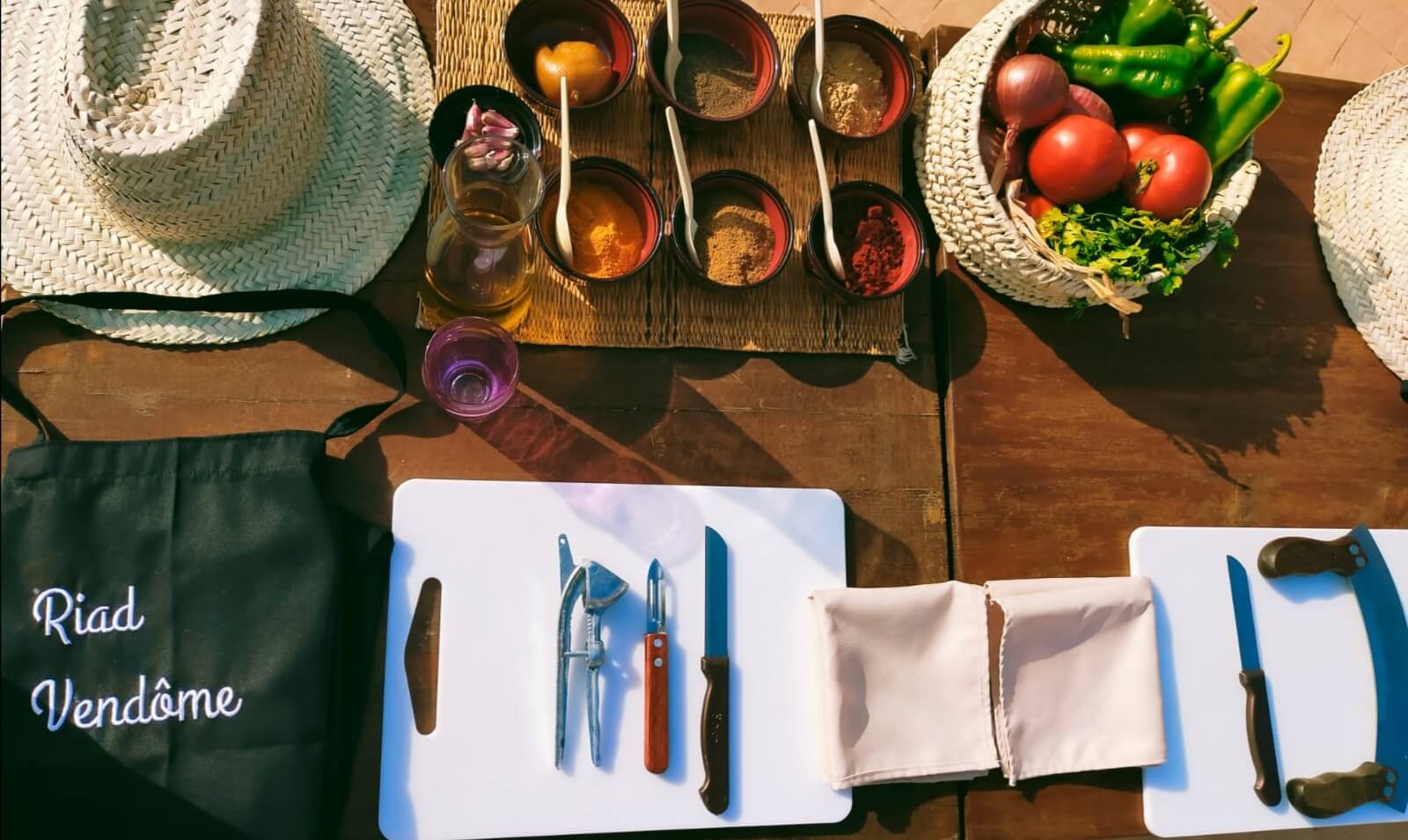
Every Moroccan cooking class at Riad Vendôme is fully adaptable for vegan, vegetarian, gluten-free, halal, nut-free and dairy-free guests. Chef Naima has over 10 years of experience adapting traditional recipes without compromising on flavour. Price: from €48/person. Groups of 4 to 20. Just mention your requirements at booking.
In brief: Cooking class for all diets in Marrakech
- Vegan, halal, gluten-free Marrakech cooking class with Chef Naima (5.0/5 on Google). Every recipe adapted at Riad Vendôme Dar El Bacha medina.
- Fully adaptable for vegan, vegetarian, gluten-free, halal, nut-free and dairy-free guests; Chef Naima has over 10 years of experience adapting recipes.
- From €48/person, groups of 4 to 20; just mention your requirements at booking.
- Direct booking / WhatsApp: +212 600 608 608
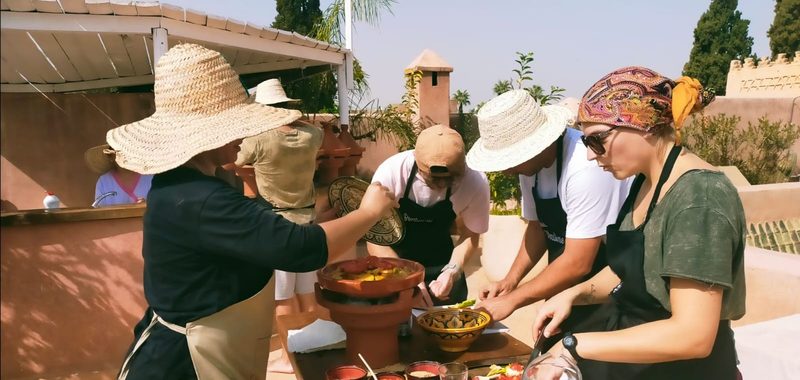
🌱 Vegan Moroccan Cooking Class
Book Your Dietary-Adapted Cooking Class
Response within 24 hours. Free quote, no commitment.
Or fill out our Reservation form
What you cook in the vegan version
Vegetable tagine with prunes and toasted almonds (or almond-free on request): the same warming spice blend as the traditional lamb version. Zaalouk: roasted aubergine and tomato with cumin and paprika. Taktouka: charred pepper and tomato salad. Stuffed courgettes with herb-spiced rice. Msemen (Moroccan flatbread, vegan). Fresh Moroccan mint tea and seasonal fruit. Every recipe is 100% plant-based, no honey, no dairy, no hidden animal products.
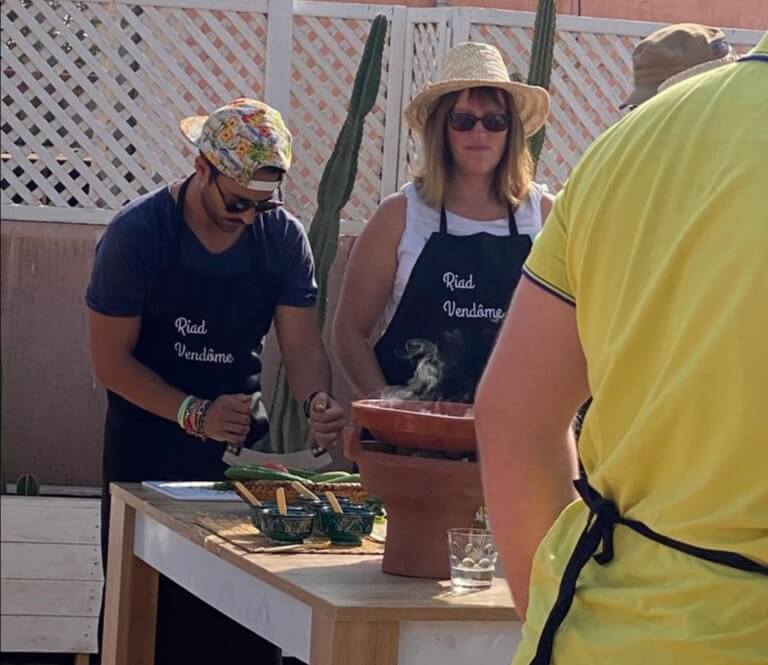
🌾 Gluten-Free Moroccan Cooking Class
What changes in the gluten-free version
Moroccan cuisine is naturally close to gluten-free. All tagines are gluten-free: cooked in earthenware with spices, meat/vegetables and no flour thickening. Couscous is replaced with quinoa or rice (both absorb the broth beautifully). Harira soup is made without vermicelli. Bastilla (pigeon pie) can be served without the pastry as a deconstructed filling, just as delicious. Bread (khobz) is skipped or replaced with gluten-free flatbread. Please inform us at booking so we can source the right ingredients.
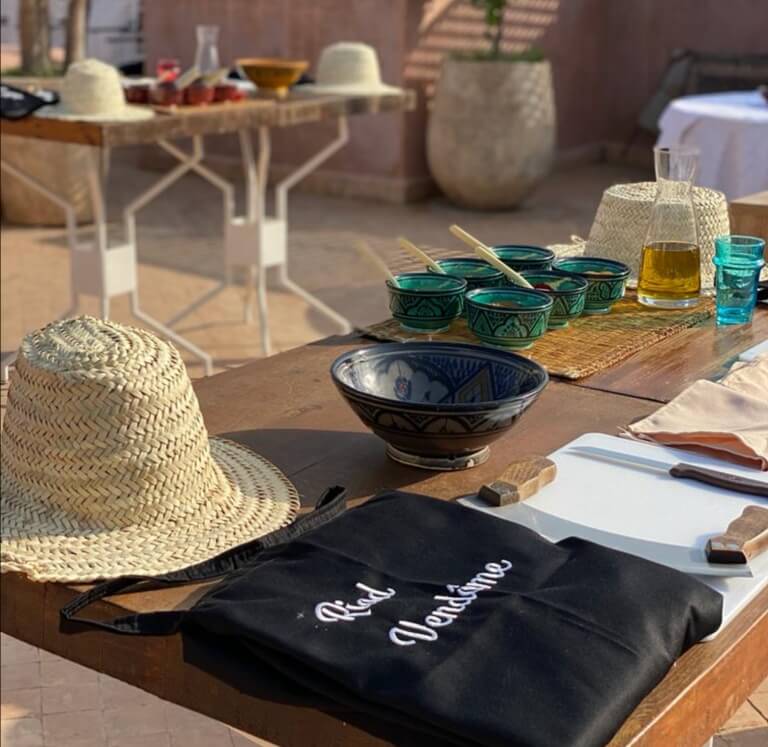
✔ Halal Moroccan Cooking Class
Halal sourcing at Riad Vendôme
All meat used at Riad Vendôme, lamb, chicken, beef, is sourced daily from halal-certified butchers in the Marrakech medina. No alcohol is ever used in cooking (wine is sometimes used in French cuisine but never in traditional Moroccan recipes). The cooking class menu is entirely halal by default. No special request needed.
⚠ Nut-Free & Allergy-Friendly Cooking Class
Nut allergies and other intolerances
Traditional Moroccan cooking uses almonds in bastilla and some tagines. If you have a nut allergy, Chef Naima will prepare nut-free versions of all dishes, replacing almonds with seeds or simply omitting them. Dairy allergies: almost all Moroccan dishes are naturally dairy-free (olive oil is the main fat). Egg allergies: bastilla contains egg, an egg-free version can be prepared. Please list all allergies when booking so we can adapt the full menu and avoid cross-contamination.
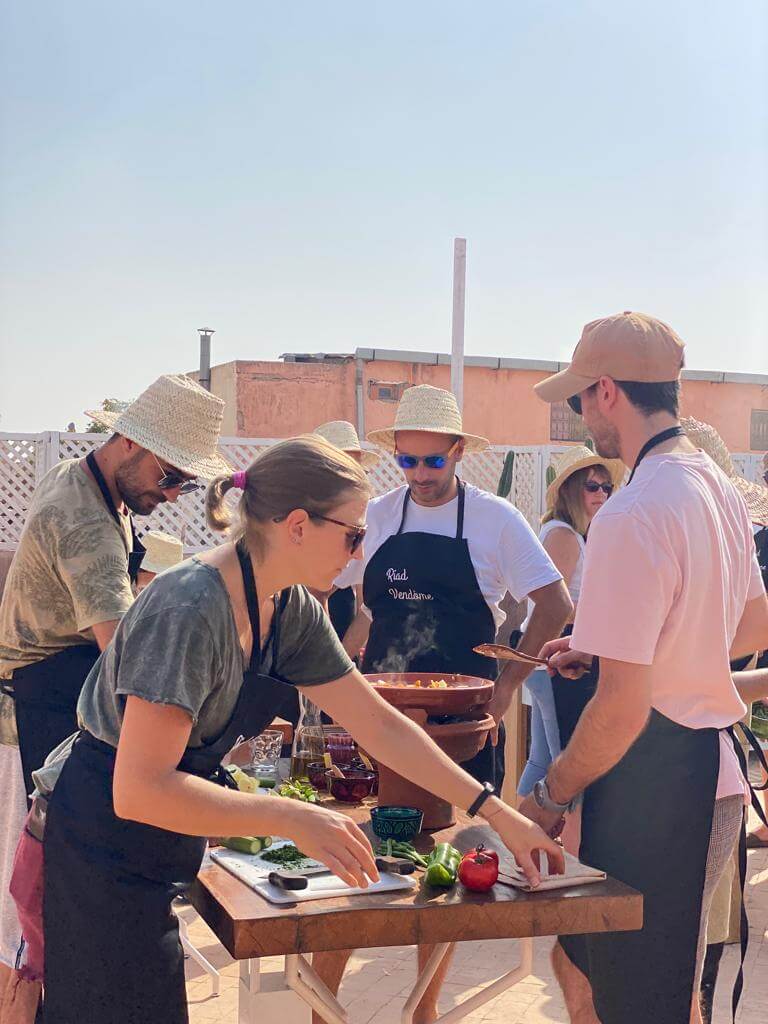
🤝 Mixed Groups - Different Diets at the Same Table
Chef Naima regularly teaches groups where some guests are vegan, some are gluten-free, and others eat everything. She prepares parallel dishes simultaneously: for example, a lamb tagine for non-vegans and a vegetable tagine for vegans, using exactly the same techniques and spice blends. This means everyone cooks together, learns the same skills, and eats together. No extra charge for mixed dietary groups.
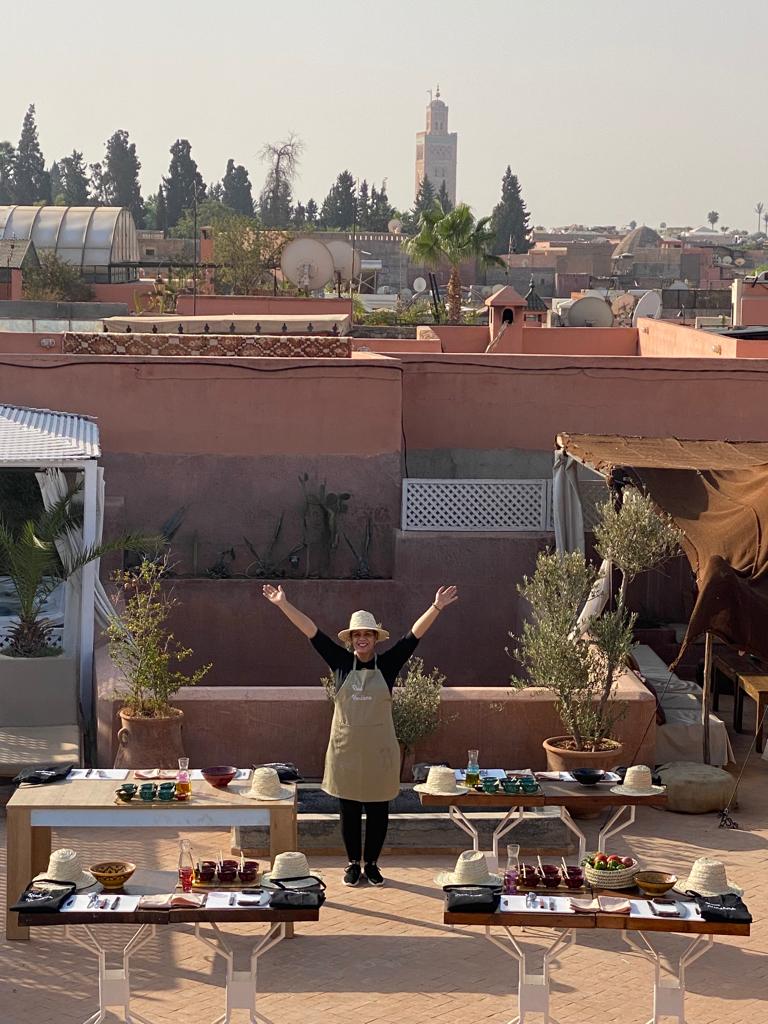
What the Class Covers - All Versions
Regardless of dietary version, every class with Chef Naima covers the same core skills: Moroccan spice blending (ras el hanout, chermoula, harissa), the art of the tagine (slow cooking, layering flavours), Moroccan salad technique (roasting, peeling, seasoning), couscous steaming (traditional couscousier method), and the ritual of Moroccan mint tea preparation. Duration: 3 hours. Includes a full shared meal of everything you cook. Groups of 4-20 persons.
Chef Naima - Rated 5/5 Google (47 reviews) · 10+ years teaching · Groups 4-20 persons
Why Moroccan Cooking Adapts More Easily Than People Expect
If you have spent years explaining yourself in restaurants abroad and still ending up with the same plain plate, Morocco tends to be a pleasant surprise. Moroccan home cooking was never built around a central piece of meat with everything else arranged around it as decoration. The backbone of the everyday table is vegetables, pulses and bread: aubergine, courgette, pepper, pumpkin, chickpea, lentil, olive, preserved lemon. Meat is frequently a flavouring rather than the point of the dish, so taking it out rarely leaves a hole where the recipe used to be.
There is a structural reason as well as a culinary one. Moroccan households cook for everybody at once: grandparents, small children, someone fasting, someone who does not eat this or that. The kitchen is used to producing several dishes from one set of ingredients on one working surface and putting them on the table together. That habit is exactly what a guest with a dietary requirement needs: a cook who does not treat an adaptation as an interruption to the real work. For how a session itself runs, see our Moroccan cooking class page; this one deals only with the adaptation.
What Genuinely Needs Substituting, and What Does Not
It helps to know before you arrive which parts of a Moroccan menu already suit your requirement and which parts have to be rebuilt. What follows is described purely in terms of ingredients and technique. It is not advice about what is right for you.
- Vegetarian: usually the smallest change of all. Salads, vegetable tagine, bread, pulses and tea are untouched. What is swapped is the base liquid: a meat or poultry stock becomes a vegetable one, built from the same onion, coriander stalk, ginger and saffron, so the dish still tastes like itself rather than a diluted version of itself.
- Vegan - the stock again, plus butter and smen (aged clarified butter) replaced with olive or argan oil, and honey replaced in the sweet elements. Milk in the tea glass is not traditional here, so mint tea needs no adaptation beyond the sugar question, which is yours to settle.
- Gluten: the bigger job, and the one that most needs warning. Tagines are the easy part, since they are not thickened with flour. What must be replaced is the wheat scaffolding around them: bread, the semolina in couscous, the pastry leaves of bastilla, the vermicelli in soups, the flatbreads. Substitute grains behave differently under steam.
- Dairy - less of an obstacle than in European cooking, because olive oil rather than butter carries most savoury Moroccan dishes. Where it does appear it is predictable: butter or smen stirred through couscous at the end, milk-based desserts, butter at breakfast. Each is a substitution rather than a redesign.
- Nuts - almonds are the ones to watch. They appear toasted over sweet tagines, ground into pastry work and sweets, and scattered across couscous. They can be left out of savoury dishes without the recipe collapsing, but they are genuinely present in a Moroccan kitchen and we will not pretend otherwise.
The Pitfalls Travellers Actually Meet in Morocco
Bread is the first. Khobz arrives with almost everything and is used as a utensil as much as a food, so a plate containing no wheat can still reach you beside a basket of it without anyone thinking they have done anything wrong. Semolina is the second: couscous is wheat, and so are the fine pasta strands in some soups, easy to miss once they have softened.
Stock and fat are the quiet ones, and they catch experienced travellers as often as first-timers. A vegetable dish may have been started in a meat broth. A couscous may have butter or smen worked through the grain at the very end, long after anyone was watching the pot. Almonds, meanwhile, turn up in sweet and savoury places at once: pastries, sweets, and the top of tagines where a sweet element is part of the recipe.
Then there is cross-contamination, which is the honest one. A working riad kitchen prepares several menus in the same room on the same day, with shared boards, pans, oil and hands. We separate what can be separated and sequence the work so adapted dishes are made first, on clean equipment, before the allergen has been in use. That is care, and care is not certification. The difference has its own section below.
Why Telling Us in Writing at Booking Matters More Than Telling Us on the Day
The single most useful thing you can do is write your requirements down when you book, rather than mention them as you walk into the kitchen. The reason is practical. The shopping for your class happens that morning, at the market, before you arrive, and what comes back in the baskets is what you cook. A requirement raised afterwards cannot change what was bought, and improvising around a missing ingredient produces exactly the compromised plate you came here to avoid.
Writing also removes the language problem. Spoken across an accent and a translation, no dairy and no problem have a habit of turning into the same sentence. A written list, sent by WhatsApp or through our reservation form, survives being passed from the person taking your booking to the person doing the shopping to the person at the stove.
Worth including: the ingredient itself rather than the label for the diet, whether it is a preference, an intolerance or a diagnosed allergy, whether traces are a problem for you, anything you have reacted to before, and how many people in your party share the requirement. Naming the ingredient travels between languages far better than naming the diet.
When the Group Has Requirements That Conflict
The worst version of a group cooking class is the one where the person with the requirement is handed a small pan in the corner while everybody else does the real thing at the main bench. We build the session the other way round, planning outward from the most restricted requirement in the room, so the shared foundation, spice work, salads, vegetable preparation, bread or its replacement, tea: is something everyone present can eat and everyone present helps to make.
Divergence then happens late and in parallel, at the point where a protein or a grain goes in, and at the same bench rather than in another room. Everybody learns the same techniques in the same order, and everybody sits down to a table where the adapted dishes are part of the spread instead of a separate tray with a name on it. For larger parties carrying several requirements, the group cooking class page explains how bigger sessions are organised.
What You Take Home: Recipes That Work in Your Own Kitchen
A recipe you can only reproduce in Marrakech is a souvenir rather than a skill. Much of the point of an adapted class is that you leave able to cook the adapted version at home, using what your own shops actually sell.
The substitutions we use are therefore chosen partly for whether they survive the journey home. Where a Moroccan ingredient has no comfortable equivalent abroad, Chef Naima explains what it is doing in the dish, the sourness preserved lemon brings, the savoury depth of smen, what ras el hanout is perfuming, so you can judge what to reach for instead of copying a list blindly. You also leave with the order of operations, where most tagines are won or lost: what goes in cold, what is browned first, how little liquid is needed, how long the pot is left alone. Her way of teaching that is described on the Chef Naima page.
Eating Elsewhere in Marrakech With a Restriction
You will not eat every meal at the riad, so it is worth knowing how to ask outside it. In the medina, the most reliable approach is to name the ingredient rather than the diet. Asking whether a dish contains butter, or whether the broth was made with meat, gets a clearer answer than asking whether something is vegan, a word that does not always carry.
A few phrases do most of the work. Bla lham is without meat, bla zebda without butter, bla hlib without milk, bla loz without almonds. Written on your phone and shown rather than pronounced, they work where you and the kitchen share no common language. Ask before the dish is made rather than after it arrives: a kitchen will cheerfully adjust something not yet started, and can do little about something already in front of you.
Grilled dishes, cold salads and pulse-based soups are generally the easiest things to order with confidence in a small medina restaurant, because every component is visible or easy to ask about. Pastries, and anything introduced as the house speciality, deserve a question about almonds. Tell us where you are heading and we will say honestly whether we think it will work.
Allergy Severity: What a Working Kitchen Can and Cannot Promise
This section is deliberately blunt, because every alternative is worse. Riad Vendôme has one kitchen. It handles wheat flour, semolina, almonds, eggs and dairy on an ordinary day, for breakfast, for the class and for the table afterwards. It is not a certified allergen-free facility. There is no separate allergen-free room, no separate equipment store and no separate air. We can cook a dish without an ingredient. We cannot promise that no trace of it exists anywhere in the room.
What we can do, and do: buy the specific ingredients for you that morning, prepare your dishes first on cleaned equipment before the allergen has been handled, keep them covered and apart from the rest of the service, and tell you precisely what went into each one so you can decide with accurate information. What we will not do is offer a guarantee we are in no position to honour.
If your allergy is the severe kind, where a trace is the issue rather than a portion, write to us with the detail before you book rather than after: the allergen, the level of exposure that is a problem for you, and what you would normally require of a kitchen. We would far rather have that conversation and tell you straight that a shared medina kitchen is not the right setting for you than take the booking and hope. Nothing here is medical or nutritional advice; what is safe for you is a decision for you and your doctor, and we will work to whatever you tell us.
Frequently Asked Questions: Dietary Options
Can vegans do a Moroccan cooking class at Riad Vendôme?
Yes. Chef Naima offers a fully vegan Moroccan menu: vegetable tagine, Zaalouk, Taktouka, stuffed courgettes, Moroccan mint tea. All dishes are 100% plant-based, no dairy, no honey, no hidden animal products. Price: €48/person. Book via WhatsApp mentioning "vegan".
Is the Moroccan cooking class gluten-free?
Yes. Moroccan tagines are naturally gluten-free. Couscous is substituted with quinoa or rice. Bastilla can be prepared without pastry. Bread is replaced with gluten-free flatbread. Just inform Chef Naima at booking, 24h notice needed to source ingredients.
Is the cooking class halal?
All cooking at Riad Vendôme uses 100% halal-certified ingredients sourced daily from the Marrakech medina. No alcohol is ever used in cooking. No special request needed, all classes are halal by default.
How much does the dietary-adapted cooking class cost?
The price is the same for all dietary versions: €48/person (3-hour class including the full meal). No extra charge for vegan, gluten-free, nut-free or mixed dietary groups. For the Spa + Cooking Day Pass: €97/person (hammam + massage + cooking class).
What if some guests are vegan and others are not?
Chef Naima prepares parallel dishes simultaneously: a lamb tagine for non-vegans and a vegetable tagine for vegans, using the same techniques. Everyone cooks and eats together. No extra charge for mixed dietary groups.
How do I book a cooking class with dietary requirements?
Contact Éric via WhatsApp (+212 600 608 608) and list your dietary requirements. Chef Naima needs 24 hours notice to source specific ingredients. All dietary adaptations are included in the standard price of €48/person.
Can guests from the US and Canada join the cooking class?
Yes. The class is led by Chef Naima with full English translation by Éric, the owner, so it suits English-speaking guests from the US and Canada. There are no non-stop flights from the United States; from New York allow about 8 to 9 hours via Casablanca on Royal Air Maroc, and Canada has a seasonal non-stop from Montreal to Casablanca. Most North American guests take the class during a few-day stay at the riad.
Where exactly is Riad Vendôme located in Marrakech?
Riad Vendôme is at 217 Derb El Halfaoui, in the Dar El Bacha district of the Marrakech medina. It is a 7-minute walk from Jemaa El-Fna square, close to the Koutoubia and the souks, so you reach the main sights on foot without needing a taxi. A member of staff meets you at the nearest vehicle drop-off point on arrival.
Can the whole riad be privatised, and for how many guests?
Yes, Riad Vendôme can be hired exclusively. The main riad has 12 rooms and goes up to 20 rooms with a partner riad 100 metres away, for exclusive hire of up to 50 guests. During an exclusive hire there are no other guests: the pool, hammam, jacuzzi and rooftop are reserved for your group alone.
Why does it matter that I send my requirements in writing before arriving?
Because the shopping for your class is done at the market that morning, before you reach the kitchen. What comes back in the baskets is what you cook. A requirement mentioned once the shopping is finished cannot change what was bought. Written notes also survive being passed from the person taking your booking to the person at the stove, which spoken instructions across a language boundary often do not.
Can you guarantee a completely nut-free or gluten-free environment for a severe allergy?
No, and we will not say otherwise. Our kitchen handles almonds, wheat flour, semolina, eggs and dairy every day, in one room with shared equipment. We can cook without an ingredient, prepare your dishes first on cleaned equipment and tell you exactly what is in them. We cannot certify an allergen-free environment. If traces matter to you, describe your allergy in detail before booking so we can be honest about whether this suits you.
Is bread served with everything, and can it simply be left off?
Khobz does accompany almost every Moroccan dish and is used as a utensil as much as a food, which is why it can appear beside a plate that was otherwise prepared without wheat. It can be left off your setting entirely, or replaced with an alternative flatbread. Tell us at booking, because it is the sort of thing a kitchen puts on the table automatically unless asked not to.
Do Moroccan dishes hide butter or meat stock where I would not expect them?
Sometimes, yes. A vegetable dish may have been started in a meat broth, and butter or smen is occasionally worked through couscous grain at the very end, after the visible cooking is done. Neither is obvious on the plate. In an adapted class the base liquid is built from vegetables and the fat is olive or argan oil, and Chef Naima names each component as it goes into the pot.
Will I end up cooking on my own if I am the only person with a requirement?
No. The session is planned outward from the most restricted requirement present, so the shared foundation of spice work, salads, vegetable preparation and tea is something everyone can eat and everyone makes together. Dishes only diverge late, when a protein or a grain goes in, and that happens at the same bench. Adapted plates arrive as part of the shared table rather than as a separate tray.
Will the adapted recipes work in my own kitchen at home?
That is the intention. Substitutions are chosen partly for whether they can be found outside Morocco. Where an ingredient has no comfortable equivalent abroad, Chef Naima explains what it contributes to the dish, so you can judge what to use instead rather than copying a list blindly. You also leave with the order of operations, which is where most tagines are won or lost.
How should I explain a dietary requirement in a Marrakech restaurant?
Name the ingredient rather than the diet, and ask before the dish is made rather than after it arrives. Useful phrases include bla lham for without meat, bla zebda without butter, bla hlib without milk and bla loz without almonds. Written on your phone and shown rather than pronounced, they work where no common language exists. Grilled dishes and cold salads are usually the easiest to ask about.
The Riad Vendôme is classified by the Moroccan Ministry of Tourism.