
 Français
  English
  Español
  Italiano
  Deutsch
  Nederlands
  Português
  Polski
  Norsk
Norsk  Svenska
  Dansk
Dansk What to See in the Moroccan Desert: Merzouga, Zagora & the Sahara
Morocco's desert is one of the world's most varied landscapes, you won't just see sand. From the towering orange dunes of Erg Chebbi to UNESCO kasbahs, volcanic plateaux, and ancient palm groves, here is everything worth seeing on a desert circuit from Marrakech.
In brief: What to see in the Moroccan desert
- Todra Gorges: 300m high walls, just 10m apart at their narrowest, near Tinghir.
- Draa Valley: over 200km of palm groves between Ouarzazate and Zagora, an estimated three million date palms.
- Aït Benhaddou: UNESCO World Heritage fortified ksar, 1.5-2 hours to explore.
- Direct booking / WhatsApp: +212 600 608 608
Erg Chebbi - Morocco's Most Spectacular Dunes
Book Your Desert Circuit
Response within minutes. Free quote, no commitment.
Or fill out our Reservation form
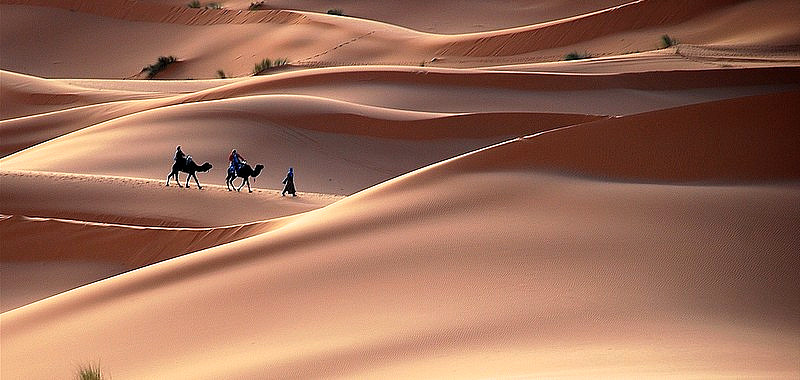
The star of any Merzouga circuit, Erg Chebbi is a sea of orange dunes rising up to 150 metres near the Algerian border. The best moments are sunrise and sunset, when the colours shift from deep amber to pale gold. A camel trek to the luxury bivouac at dusk is the experience most travellers remember for a lifetime. Erg Chebbi is accessible on both our 3-day and 4-day Merzouga circuits.
Todra Gorges: A 300-Metre Rock Cathedral
Carved by the Todra river over millennia, these dramatic gorges near Tinghir reach 300 metres high with walls just 10 metres apart at their narrowest point. The light changes throughout the day, making midday (when the sun hits the canyon floor) a magical moment. Most of our circuits include a stop here on the drive to or from the desert. Bring good walking shoes, the valley floor walk is worth every step.
Chigaga Dunes: The Untouched Sahara
If Merzouga feels crowded, the Chigaga dunes near Zagora offer something rarer: a vast, isolated erg stretching to the horizon with almost no other visitors. Accessible only by 4×4, Chigaga is the Sahara as it was before mass tourism, silent, immense, and humbling. Our 4×4 Grand South circuit includes an overnight at a private bivouac in Chigaga.
Draa Valley: The Longest Palm Grove in Africa
Stretching over 200 km between Ouarzazate and Zagora, the Draa Valley is lined by an extraordinary ribbon of date palms, estimated at three million trees. Villages of golden pisé (earthen architecture) appear like mirages. The valley is also rich in prehistoric rock carvings and ancient ksour (fortified villages) that most tours drive straight past. We always stop.
Aït Benhaddou: UNESCO World Heritage Ksar
One of Morocco's most photographed sites, this fortified mud-brick citadel near Ouarzazate has appeared in dozens of films, Gladiator, Game of Thrones, The Mummy. Built along an ancient trans-Saharan trade route, it is a living museum of southern Moroccan architecture. Allow 1.5 to 2 hours to explore properly. Our circuits always include a guided walk through the ksar.
Djebel Saghro: Volcanic Landscapes Between Two Deserts
One of Morocco's best-kept secrets, Djebel Saghro is a volcanic massif between the High Atlas and the Sahara, featuring black basalt peaks, ochre canyons, and ancient Aït Atta Berber villages almost unchanged for centuries. Accessible only by 4×4, it is a highlight of our Grand South circuit and offers some of the most surreal landscapes in the entire country.
Merzouga or Zagora, Which Desert is Best?
The choice depends on what you prioritise:
| Merzouga (Erg Chebbi) | Zagora (Draa Valley) | |
|---|---|---|
| Distance from Marrakech | 560 km / 7-8h drive | 370 km / 5-6h drive |
| Dune height | Up to 150m, spectacular | Up to 30m, more accessible |
| Crowd level | Busier (most popular) | Quieter, more authentic |
| Best for | Classic Sahara experience, photographers | Budget travellers, first desert visit |
| Minimum circuit | 3 days / 2 nights | 2 days / 1 night |
Éric's personal recommendation: if you have 4 days, combine both on our Merzouga + Zagora circuit. If you only have 3 days, Merzouga wins.
Beyond the dunes, the southern road also passes the old mellahs and Jewish cemeteries of Ouarzazate and the Draa valley, see our Jewish heritage itinerary from the riad.
Can you see the Sahara from Marrakech?
No, the Sahara is 5-8 hours by road from Marrakech. You need at least 3 days for a return desert circuit. One-day "desert excursions" advertised from Marrakech typically only reach the foothills of the Atlas.
What is the best time of year to visit the desert in Morocco?
October to April is ideal, pleasant temperatures during the day (18-28°C) and cool, clear nights. July and August are extremely hot (40°C+) and generally not recommended. See our full seasonal guide.
How many days do you need for a desert circuit from Marrakech?
A minimum of 3 days is needed to reach the Merzouga dunes and return. 4 days allows you to include more stops (Todra Gorges, Aït Benhaddou) and makes the journey far less rushed. We offer circuits from 3 to 7 days.
Is Aït Benhaddou worth a visit?
Absolutely. Even if you have seen photographs, visiting in person is a completely different experience. Arrive early (before 9am) or late afternoon to avoid coach tour crowds. Our circuits time the visit accordingly.
Want to see it all for yourself?
Our all-inclusive desert circuits from Marrakech start from €280/person, riad + transport + bivouac + meals.
› Browse all desert circuits · WhatsApp +212 600 608 608
⭐ Google 4.2/5 (617 reviews) · ✈️ TripAdvisor 4.2/5 · 🎉 500+ events organised since 2013
What are the must-see Moroccan desert highlights for a short 2-day trip from Riad Vendôme?
For a short 2-day desert trip from Marrakech, the must-see highlights are: Day 1 morning, Tizi n'Tichka Atlas pass (2260m, panoramic photo stops), Ait Ben Haddou kasbah (UNESCO World Heritage); Day 1 afternoon, arrival Zagora oasis or Erg Chigaga dunes (camel ride sunset + dinner in Berber camp under stars); Day 2 morning, sunrise camel ride or sandboarding, Berber breakfast in camp; Day 2 afternoon, Draa Valley palm groves on return. Riad Vendôme arranges all stops in private 4x4 with English-speaking guide. From €195/person all-in.
What is the most flexible itinerary for seeing Moroccan desert highlights from Riad Vendôme?
The most flexible desert itinerary lets you customise stops based on interests: photography lovers add Ouarzazate film studios (Game of Thrones, Gladiator), foodies add Berber lunch in nomad tent, architecture fans add Telouet kasbah ruins, geology enthusiasts add Todra Gorge. Éric proposes pre-built itineraries or customises from scratch: single private 4x4 means you stop where you want, for as long as you want. Modifications possible up to 24h before departure (within reason of route). One coordinated trip, multiple personalised highlights.
How do I reach Marrakech from the US and Canada to start the desert circuit?
Desert circuits start from Marrakech, so you first fly into Marrakech-Menara and base yourself at the riad. There are no non-stop flights from the United States; from New York allow about 8 to 9 hours via Casablanca on Royal Air Maroc, which hubs there. From Canada, Royal Air Maroc runs a seasonal non-stop from Montreal to Casablanca, then a short connection. Most North American guests spend a few days at the riad in the medina before setting off on the desert circuit.
How much does a desert circuit cost for one person, a couple or a family of four?
Our all-inclusive desert circuits from Marrakech start at €280 per person. The rate is per person and all-inclusive: transport in an air-conditioned 4×4 or minibus with driver, nights at the riad in Marrakech, the bivouac night, full board on the road and the camel ride at sunset. Because a private departure pays for the vehicle once, the price per head falls as the group grows: a family of four sharing one private 4×4 pays noticeably less per person than a couple travelling alone. Send your exact dates by WhatsApp to +212 600 608 608 for a firm reply within minutes on WhatsApp, and a detailed quote within 24 hours, a price is never quoted blind.
How long is the drive from Marrakech to the desert?
Marrakech → Merzouga: 560 km, about 7 to 8 hours by road via Aït Ben Haddou, Ouarzazate, the Dadès valley and the Todra gorges. Marrakech → Zagora: about 360 km, 5 to 6 hours over the Tizi n'Tichka and down the Draa valley. The two deserts are themselves some 360 km apart (about 6 hours), which is why combining the two needs at least 4 days. Photo stops, mint tea and lunch are built into every road day, the drive is part of the trip, not lost time.
Do you need a 4×4 for the Moroccan desert?
Not for the main roads: they are tarmac all the way to Merzouga and to Zagora, and an air-conditioned minibus is perfectly comfortable. A 4×4 becomes necessary for the last off-road stretch, the piste to the camps at the foot of the Erg Chebbi, and above all the crossing to the erg Chegaga (also spelled Chigaga) beyond M'hamid, which is around 2 hours of dunes and stony track. Riad Vendôme coordinates the vehicle and the driver in collaboration with an approved licensed transport partner; you choose private or shared when you book.
Merzouga or Zagora: which desert should you choose, Erg Chebbi or erg Chegaga?
Merzouga and its Erg Chebbi are the postcard Sahara: dunes up to 150 m, orange at sunrise, but 560 km and 7 to 8 hours from Marrakech, so 3 days minimum. Zagora and the erg Chegaga (Chigaga) are closer, 360 km and 5 to 6 hours, and work in 2 days / 1 night; the Chegaga dunes are wilder and far less visited, but reaching them adds about 2 hours of 4×4 piste from M'hamid. Short trip: Zagora. Iconic dunes: Merzouga. Both: the 4-day Grand Tour. The full comparison is on our Merzouga vs Zagora page.
Is it cold at night in the Sahara?
Yes, and it catches most first-timers out. From November to February the temperature in the erg drops to roughly 0 to 5 °C after dark, even after a 25 °C afternoon. The bivouac tents have real beds with thick wool blankets and the camp lights a fire, but pack a fleece or a down jacket, a hat, socks and long trousers for the evening. From April to October the nights are mild and one light layer is enough. Full packing list on our preparation guide.
How does a night in a desert bivouac actually work?
You reach the edge of the dunes in the late afternoon and ride out by camel at sunset, 30 to 45 minutes, slow and suitable for complete beginners. The camp is a circle of nomad tents with real beds, proper mattresses and blankets, and shared or private washrooms depending on the camp. Dinner is a Berber tagine served under the tent, then drums and mint tea around the fire, and a sky with no light pollution at all. Wake-up is before dawn to climb the nearest dune for sunrise, breakfast at the camp, then the road back.
Can you do the desert with children or with a baby?
Yes, families are a large share of our departures. The road day is the only real constraint and it is broken up with stops. Éric recommends the Zagora circuit for younger children: 5 to 6 hours of driving instead of 7 to 8, and a shorter night away. Bivouac tents have real beds, camel rides are gentle and a small child can ride with a parent. Travelling with a baby, say so when you book so the partner fits a suitable car seat and the camp sets aside a quieter tent.
Is a desert circuit in southern Morocco safe?
Southern Morocco is one of the calmest and most travelled parts of the country, and the Marrakech, Ouarzazate, Merzouga axis is a well-maintained tourist road. The circuit is coordinated in collaboration with an approved licensed transport partner, professional drivers who know the passes, and with official guides for the visits. The camps are permanent, staffed and reachable by telephone. Mobile coverage is patchy in the middle of the erg, which is part of the charm: leave the camp number with your family. Otherwise it is common sense: drink plenty of water, cover your head, and never walk off into the dunes alone.
Can you combine the desert circuit with a stay at the riad, the spa and a cooking class?
That is how most guests do it, and it is why the riad is the anchor point. You arrive at Riad Vendôme in the Marrakech medina, take a night or two to settle in, leave for the desert, then come back to the same room. On the return day the spa books a hammam and a massage, and the cooking class with Chef Naima, 3 hours, market, tagine and couscous, lunch included, is €48 per person. Luggage you don't need in the desert stays at the riad.
How do I book a desert circuit and get a quote?
Send your dates, the number of travellers and the format you have in mind by WhatsApp to +212 600 608 608, or use the form on this page. Éric replies personally, in English, with a detailed programme and a firm reply within minutes on WhatsApp, and a detailed quote within 24 hours: no automated booking engine and no deposit taken before you have agreed the programme. Riad Vendôme coordinates the circuit in collaboration with an approved licensed transport partner and official guides, and stays your anchor point in Marrakech. You can also book your room at the riad first.
Where exactly is Riad Vendôme located in Marrakech?
Riad Vendôme is at 217 Derb El Halfaoui, in the Dar El Bacha district of the Marrakech medina. It is a 7-minute walk from Jemaa El-Fna square, close to the Koutoubia and the souks, so you reach the main sights on foot without needing a taxi. A member of staff meets you at the nearest vehicle drop-off point on arrival.
Can the whole riad be privatised, and for how many guests?
Yes, Riad Vendôme can be hired exclusively. The main riad has 12 rooms and goes up to 20 rooms with a partner riad 100 metres away, for exclusive hire of up to 50 guests. During an exclusive hire there are no other guests: the pool, hammam, jacuzzi and rooftop are reserved for your group alone.
When should I go to the Moroccan desert in 2027?
The best windows in 2027 are the same as every year: March and April in spring, October and November in autumn. December and January work too, with cold nights under the tent. In summer the circuit leaves earlier in the morning. One 2027 detail worth knowing: Easter falls on 28 March, a week earlier than in 2026, so the spring rush starts a week earlier. Departures for 2027 can be booked now.