
 Français
  English
  Español
  Italiano
  Deutsch
  Nederlands
  Português
  Polski
  Norsk
Norsk  Svenska
  Dansk
Dansk 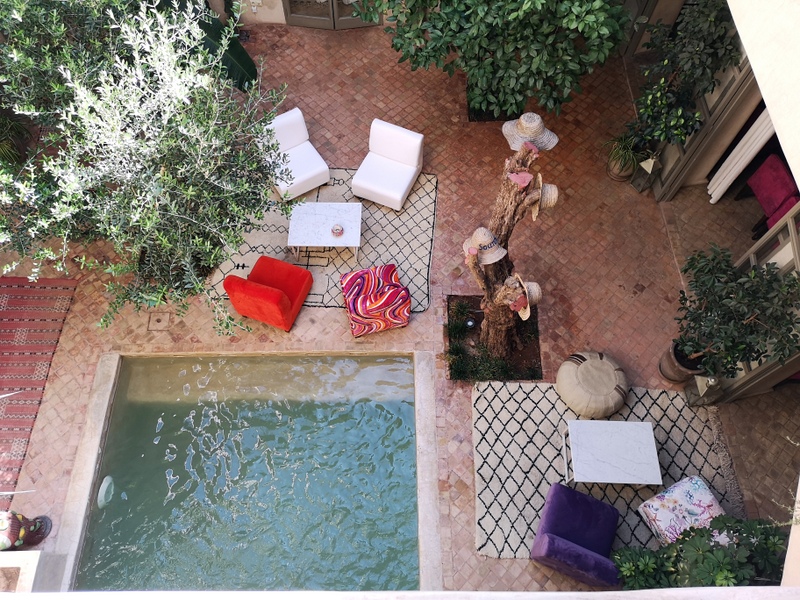
Home › When to visit › Winter sun in Marrakech
Winter Sun in Marrakech: The Warm Riad to Come Home To
Marrakech stays mild in winter, 18 to 25°C in the day, 5 to 10°C at night, and Riad Vendôme is built for it: patio pool, traditional hammam, rooftop jacuzzi at 36°C and a patio cover that raises daytime temperatures by 6 to 8°C. Rooms with Moroccan breakfast, 7 minutes' walk from Jemaa el-Fna. One contact throughout: Éric, owner since 2011: WhatsApp +212 600 608 608, written quote within minutes.
When winter bites back home, winter sun in Marrakech is barely a 3-4 hour flight away, and at Riad Vendôme the word warm means two things at once. There is the climate: dry, bright days of roughly 18-22°C and around 300 days of sunshine a year, with the snow-capped Atlas on the horizon. And there is the cocoon: a riad designed to be lived in during winter, with a hammam, a jacuzzi heated to 36°C, a patio sheltered under a transparent cover, a fireplace and Chef Naima’s home cooking. Most winter-sun destinations sell you the weather. We give you the weather and a warm welcome to come home to every evening.
In brief: Winter Sun in Marrakech
- Marrakech offers a winter sun escape with dry, bright days of roughly 18 to 22 degrees and around 300 days of sunshine a year, barely a 3 to 4 hour flight from much of Europe.
- At Riad Vendôme the patio is fitted in winter with a transparent cover that creates a passively heated courtyard, alongside a hammam, a jacuzzi heated to 36 degrees, a fireplace and half-board cooking by Chef Naima.
- The calmest, most luminous stretches sit outside the peak weeks, while the February half term suits families across 12 rooms, or up to 20 with a partner riad 100 m away.
- Direct booking / WhatsApp: +212 600 608 608
Why Marrakech is a winter sun destination
Marrakech enjoys one of the most reliable winter climates within easy reach of Europe: long sunny days, low humidity and cool, clear nights. You can wander the souks, palaces and gardens in shirtsleeves at midday, then watch the light turn gold over the medina. Because it sits just a short flight from the cold, it is the natural choice for a winter break or a longer escape from grey skies, without the long-haul jet lag. For a month-by-month view, see when to visit Marrakech.
The cocoon after dark
Winter days are warm, but evenings cool quickly once the sun drops, and that is exactly where a riad earns its place. Our central patio is fitted with a transparent cover that creates a natural greenhouse effect, keeping the courtyard mild and full of light by day while softening the night-time chill. Warm up in the hammam and spa, sink into the jacuzzi at 36°C, gather by the fireplace, and sit down to a half-board dinner prepared by Chef Naima. It is the difference between a hotel room and a home for the week. The full detail of the cover and our other measures is on our eco-friendly commitment page.
Low season: the smart winter escape
Outside the peak weeks, this is the calmest, most luminous time to be here: quieter souks, unhurried mornings and the gentle rates of low season. It is the ideal moment for a private riad takeover with friends or family, the whole house, one courtyard, one table, or simply a serene couple’s retreat. You get the same winter sun with far fewer crowds, and the run of the place.
February half term with the family
For UK half term and the February school holidays, Marrakech is hard to beat: a short flight, comfortable daytime warmth and plenty to keep every age happy. Our 12 rooms (up to 20 with a partner riad 100 m away) include family configurations, with a pool, the jacuzzi and a sheltered patio for downtime between outings. Add a night in the desert under the stars and you have a half term the children will remember. Plan the trip with our flights guide and family stay page.
Marrakech month by month in winter
Each winter month in Marrakech has its own character, here is what to expect if you are deciding when to come.
December
Festive and lively: the medina sparkles, the rooftops catch the low winter sun and the riad cocoon comes into its own for Christmas and New Year’s Eve. Early December is calm before the holiday rush.
January
The quietest, most luminous time of year: clear skies, crisp light over the Atlas and unhurried souks. Ideal for a serene escape or a private riad takeover with friends and family.
February
School-holiday season: with UK half term falling this month, it is a favourite for families on a short-flight winter break, sunny days out and a sheltered patio to come back to.
March
Early spring energy: gardens begin to bloom, days lengthen and the city feels fresh and bright, a lovely month for walking the medina and day trips to the Atlas.
Your winter sun, whatever the occasion
The winter cocoon adapts to the reason you travel, the same sun, a different stay:
- Culture & medina - palaces, gardens and souks at their calmest: things to do in Marrakech.
- Golf - tee off under winter sun at the Royal Golf (founded 1927), Samanah (Jack Nicklaus) or Al Maaden (Kyle Phillips): a golf holiday.
- Wellness & spa - the hammam ritual is at its best when the air is crisp: spa & hammam.
- Seminars & corporate - quiet, low-season offsites with the whole riad to yourselves: seminars in Marrakech.
- Friends & hen weekends - sun by day, cocoon by night: a hen party in Marrakech.
- Couples - long lazy mornings and warm evenings for two: a honeymoon or romantic break.
- Festive season - spend the holidays in the sun: Christmas and New Year’s Eve at the riad.
Ready to plan? Book direct with the owner - one contact, one quote, no platform commission.
Why a traditional riad feels cool in winter, and why that is deliberate
Nobody tells you this before you book, so we will. A riad is designed for the Marrakech summer, not the Marrakech winter. Thick walls, stone and tadelakt surfaces and a courtyard open to the sky at the centre of the house all work to shed heat rather than hold it.
The architecture is simple once you see it. A riad turns its back on the street: almost no exterior windows, every room looking inward on to an open courtyard. That courtyard is the lung of the house, drawing warm air up and out while walls of earth, brick and lime absorb heat slowly and release it at night. Tadelakt, the polished lime plaster used on walls and in most of our bathrooms, is dense and cool to the touch; floors are tile or stone. There is none of the soft carpeted insulation a northern European house takes for granted.
In winter the same physics runs the other way: walls slow to heat up are slow to warm through, and the stone underfoot stays cool long after the sun has left it. That is not a fault in the building, which is why the useful question is not whether a riad is cool in winter, but what a riad does about it.
The afternoon and the evening are two different holidays
What visitors underestimate is never the day. The day is generous: bright, dry and around 18-22°C, warm enough that you will be carrying your coat rather than wearing it by mid-morning. What catches people out is how abruptly it ends. The sun drops behind the medina rooftops and the temperature follows within the hour, towards 5 to 10°C at night, with none of the long mild dusk you get at home.
Because the afternoon was so pleasant, the evening lands harder than the figures suggest. You spend the day in the sun in a shirt, sit down outdoors at eight o’clock in the same shirt, and the courtyard has already given its warmth back to the open sky. That is the classic first winter evening in the medina: everyone slightly too cold, nobody quite saying so. The remedy is unglamorous: treat the evening as its own event, go back to your room before dinner, and change rather than add a layer.
What actually makes a winter stay comfortable
Heating in the room. The air conditioning is hot and cold, and in winter it works as heating, that is the piece that decides whether you sleep well. Because the walls start from a cool baseline, switch it on when you head out for the afternoon rather than at ten at night, so the room meets you warm. There is also a fireplace in the house, an evening pleasure rather than a heating system. If one particular room matters to you, ask Éric before you book rather than after.
Where you spend the evening. In summer everyone lives in the courtyard and on the roof; in winter the centre of gravity moves under cover. The patio is fitted for the winter with a transparent cover that turns the courtyard into something closer to a conservatory: the light still pours in, the warmth stays, and the cover raises daytime temperatures by 6 to 8°C.
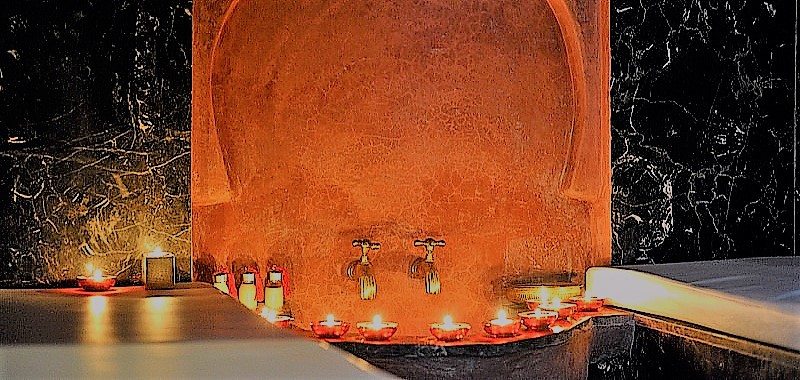
The hammam and the jacuzzi as winter attractions. In August a traditional hammam is something you steel yourself for. In January it is the best part of the day: hot steam, black soap, a scrub, and the satisfaction of walking out into cool air already warm right through. The rooftop jacuzzi at 36°C follows the same logic, better under a cold clear sky than a hot one. Guests who treat the spa as an extra in summer build the day around it in winter.
Eating under cover. Dinner in an open courtyard is the photograph everyone carries in their head, and in April it is right. In winter, ask for your table indoors or under the patio cover. Half-board with Chef Naima is worth more in winter than in any other season, because the alternative, walking into the medina at nine at night to find somewhere, is exactly what you will not feel like doing.
What to pack for a winter trip, and what people routinely get wrong
The mistake is nearly always the same: people pack for the forecast, and the forecast describes the afternoon. Pack for two climates in the same day.
- A proper jumper, not a cardigan. The evening layer visitors bring is usually one step too light. Bring the one you would wear at home in autumn.
- Something windproof and thin. A light shell over a jumper beats a heavy coat you will refuse to carry all day.
- Closed shoes and warm socks. Riad floors are tile and stone and stay cool. Slippers or thick socks for the room are the most appreciated thing in a winter suitcase, and the most forgotten.
- Sunglasses and sun cream. Counter-intuitive in December, but the winter sun sits low and shines straight into your eyes.
- Swimwear, without hesitation. Not for the pool necessarily, for the hammam and the jacuzzi.
- Lip balm and a richer moisturiser. Dry cold is harder on skin than damp cold.
- What you can leave behind: a heavy winter coat, an umbrella as your first line of defence, and any assumption that you will need beach clothes.
What is genuinely better in winter
Having been candid about the cold, here is the bigger half of the argument. The light comes first. The winter sun sits low, and low light does extraordinary things to a city built out of pink earth: walls turn copper in the late afternoon, courtyards fill with long shadows, and on clear days the Atlas stands white along the horizon. Then the quiet. The souks in high season are a test of nerve; in the low weeks they become a place you can stand still in, where traders have time to talk rather than time to sell. The monuments - palaces, gardens, tombs, are the same buildings without the queue, and if you have only ever seen them shoulder to shoulder with a tour group you have not really seen them. Flights are gentler on the budget outside the peak weeks too; our flights guide covers lining up dates and routes.
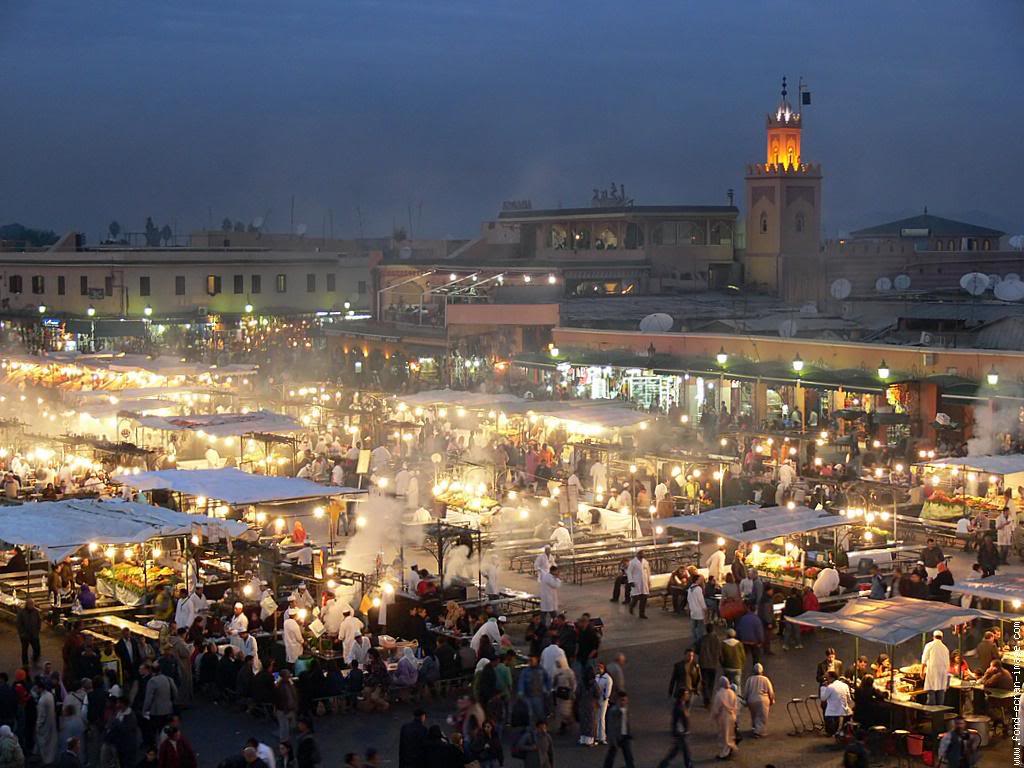
And the one people notice most: you can walk all day. In summer the middle of the day is written off, you retreat indoors and begin again at five. In winter there is no middle of the day to lose. We are a 7 minutes’ walk from Jemaa el-Fna, and in winter that walk is a pleasure rather than a calculation.
The pool in winter, answered honestly
If you are choosing a winter stay on the strength of the swimming pool, choose it on the strength of the hammam and the jacuzzi instead. The pool is a lovely thing to have in the courtyard in winter and a poor thing to build a day around.
The honest version: winter afternoons here are warm, and on a still, sunny day people do swim. But a courtyard pool sits in shade for much of a short winter day, the air after sunset falls to 5 to 10°C, and getting out is the difficult half rather than getting in. Guests who plan a winter stay around lying beside the water are usually disappointed; guests who treat it as something they might do on a bright afternoon never are. The water you will actually use is hot water. If the swimming pool specifically matters for your dates, ask what to expect when you enquire: you should have a straight answer before you book, not a brochure line.
Winter is the season for everything you would not attempt in August
The strongest argument for a winter trip is not the riad at all: winter opens up the half of Marrakech that summer closes. Day trips become sensible again. A whole day outside the city in high summer is a day of managing heat; in winter it is a day of good walking weather and clear air. The Agafay desert is at its best when the sun is not punishing, and under low winter light it is a different landscape from the hazy summer one. The mountains are within reach for a day, and winter is when they look their best, our excursions page sets out what is realistic.
Long walks become the point rather than the ordeal: a morning in the souks, an afternoon on foot between palaces and gardens, an hour sitting still with a mint tea. See things to do in Marrakech and the three-day itinerary. And long lunches become the correct use of the middle of the day: in summer you eat quickly and take cover; in winter, lunch under the patio cover in the warmest hour is the meal you remember. A cooking class with Chef Naima reads differently too. For which season suits you overall, see when to visit Marrakech; this page is only about making the winter version work.
Christmas and New Year are a different proposition from the rest of winter
It is worth separating the festive fortnight from winter in general, because nearly everything about it runs the other way. The quiet that defines the calmest weeks is not there: the riad is busy, restaurants are booked out, and the rates are at their firmest. If what you want from winter is emptiness, come in the weeks either side.
If what you want is Christmas somewhere that does not look like Christmas, it is the whole reason to come. Christmas in Marrakech is warm midday sun and a long table in a courtyard instead of a dining room at home. New Year’s Eve works the same way, and it is the one night of the winter when a full courtyard is the entire point. One practical note: book far earlier than instinct suggests, because the festive fortnight fills first and an exclusive hire of the whole house fills earliest of all.
The short version. Come in winter for the light, the quiet and the ability to walk all day. Pack a real jumper and closed shoes. Treat the hammam and the jacuzzi as the main event rather than the pool. And ask directly about heating in the room you are offered: Éric replies on WhatsApp +212 600 608 608, with a written quote within minutes.
Riad comfort in winter: heated rooms, heated patio, jacuzzi at 36 °C
Winter days in Marrakech are mild and sunny, but the nights are cool: from mid-November to early March, indoor comfort matters as much as the pool does in summer. A riad is not a hotel, and that is exactly the question most travellers ask themselves before booking in December.
At Riad Vendôme the rooms are heated, each one adjustable independently. The patio is heated whenever it is needed, from morning to evening, and the two fireplaces, one, one in the sitting room and one in the dining room, are lit every evening in winter: that is where dinner happens, by the fire, with the lit pool as a backdrop. The rooftop jacuzzi is kept at 36 °C all year round, and the patio pool is not heated: in winter it is the jacuzzi that takes over. Exact rate according to your dates, the length of the stay and the number of guests: written quote within minutes on WhatsApp.
Are the rooms heated in winter?
Yes, all the rooms are heated and each one is adjustable independently. It matters from mid-November to early March, when the nights are cool in Marrakech.
Is it cold in a riad in winter?
It is the question everyone asks, and it is a fair one: a riad is built around an open patio. Here the rooms are heated and adjustable one by one, the patio is heated whenever it is needed, from morning to evening, and the two fireplaces are lit every evening, the two fireplaces in the sitting room and the dining room are lit every evening, and the rooftop jacuzzi is at 36 °C.
Is there a fireplace?
Two: one in the sitting room, one in the dining room. They are lit every evening in winter, from mid-November to early March. That is the heart of the house at this season: you dine by the fire, with the lit patio pool as a backdrop. The days themselves are often spent on the terrace in the sun.
The rooftop sun terrace: winter sunshine, 250 m² above the medina
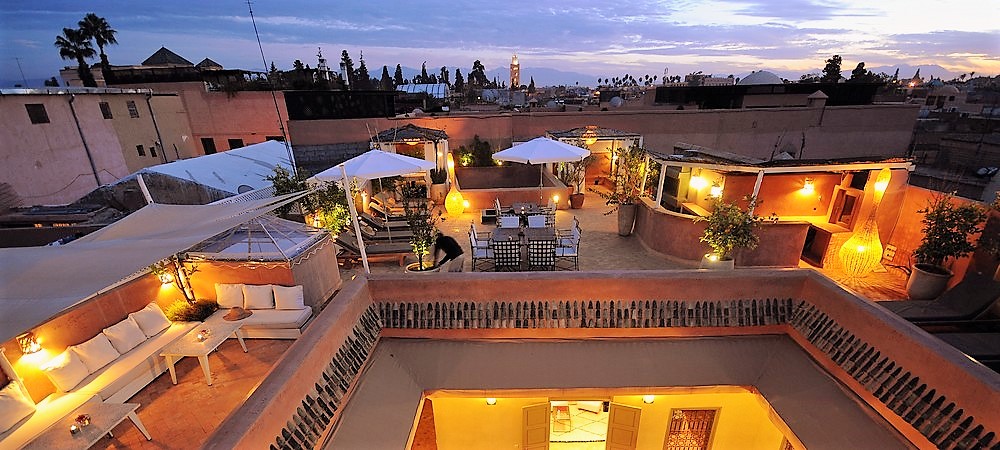
Many of our winter guests do not come to swim: they come for the sun and the warmth. In Marrakech, from November to March, the days are clear and mild, and it is up on the roof that you get the best of them. The Riad Vendôme rooftop is a proper sun terrace of 250 m²: ten sun loungers facing the sun, a lounge area with benches and cushions, the view over the Koutoubia and the snow-capped peaks of the Atlas, and the jacuzzi kept at 36 °C a few steps away. You take a late breakfast there, you have lunch there, you read there all afternoon in the sun, and you stay for the sunset. That is the winter day as our regulars spend it.
Is there a sun terrace at the riad?
Yes, the 250 m² rooftop is laid out as a sun terrace: ten sun loungers facing the sun, a lounge area with benches and cushions, and the jacuzzi kept at 36 °C. It is where the winter days are spent, when the Marrakech sun is mild and the sky is clear.
Can you sunbathe in winter in Marrakech?
Yes, and it is the very reason many of our guests come at this season: from November to March the days are clear and mild. The rooftop sun terrace, with its ten loungers, is exposed all day; in the evening you come back down to the fireside.
How many sun loungers are there on the rooftop?
Ten, spread over the 250 m² of the roof terrace, with the lounge area and the jacuzzi at 36 °C.
Frequently Asked Questions
Is Marrakech a good winter sun destination?
Yes. Marrakech has a dry, sunny winter with daytime temperatures around 18-22°C and roughly 300 days of sunshine a year, all within a 3-4 hour flight of much of Europe, one of the most reliable winter-sun options close to home.
How warm is Marrakech in winter?
Expect mild, bright days of about 18-22°C and cooler evenings. Days are comfortable for sightseeing in light clothing; nights call for a jacket, and a warm riad to return to.
Is the riad heated and comfortable in winter?
Yes. In winter we fit a transparent cover over the patio, creating a passively heated, light-filled courtyard that stays pleasant by day with very little heating. Rooms have thick traditional walls and insulation, there is a fireplace, and the jacuzzi is heated to 36°C.
When is low season in Marrakech?
The calmest stretches sit outside the peak weeks — ask for your dates, it is the only way to know: fewer crowds, beautiful light and gentle low-season rates, ideal for a private riad stay.
Is Marrakech good for February half term with children?
Very much so. It is a short flight, the daytime weather is mild, and the riad offers family rooms, a pool and a sheltered patio. A night in the desert under the stars makes an unforgettable half-term highlight.
What should I pack for winter in Marrakech?
Pack in layers: light clothes for the sunny days, a jacket or jumper for cooler evenings, comfortable shoes for the medina, sunglasses and sunscreen for the bright winter sun, and swimwear for the jacuzzi.
Can you swim or use the jacuzzi in winter?
Yes: the jacuzzi is heated to 36°C all year and, with the hammam, is the favourite way to enjoy the water in winter. The pool is best enjoyed on milder, sunny afternoons.
Where exactly is Riad Vendôme located in Marrakech?
Riad Vendôme is at 217 Derb El Halfaoui, in the Dar El Bacha district of the Marrakech medina. It is a 7-minute walk from Jemaa El-Fna square, close to the Koutoubia and the souks, so you reach the main sights on foot without needing a taxi. A member of staff meets you at the nearest vehicle drop-off point on arrival.
How do I book, and how quickly do you reply?
You book directly with the riad, not through a platform. Send your dates and group size on WhatsApp at +212 600 608 608 and you receive a written quote within minutes. There is no automated booking engine: every stay is confirmed by a person, and the payment terms are set out in the quote you receive.
Can the whole riad be privatised, and for how many guests?
Yes, Riad Vendôme can be hired exclusively. The main riad has 12 rooms and goes up to 20 rooms with a partner riad 100 metres away, for exclusive hire of up to 50 guests. During an exclusive hire there are no other guests: the pool, hammam, jacuzzi and rooftop are reserved for your group alone.
What is the bathroom like, and is there air conditioning and heating?
Each room has its own bathroom, most with a tadelakt shower, the polished lime plaster used in Moroccan bathrooms, and the hot and cold air conditioning works as heating in winter, when Marrakech nights drop close to 5°C in January. Towels, spa robes and a hairdryer are provided. Ask Éric on WhatsApp +212 600 608 608 for photos of the exact room before you book.
Why does a riad feel cool in winter when the days are warm?
Because a riad is built for the Marrakech summer. Thick earth and lime walls, tadelakt surfaces and tile floors are designed to shed heat rather than hold it, and the courtyard at the centre of the house is open to the sky. In August that keeps the house cool almost for free. In winter the same construction starts from a cool baseline and warms slowly, which is why heating and where you spend the evening matter more than the forecast does.
What do visitors most often get wrong about winter in Marrakech?
They plan for the afternoon. Winter days here are bright and around 18-22°C, so people go out in a shirt and end up carrying their jacket. The evening is what catches them out: once the sun drops behind the rooftops the temperature falls quickly, towards 5 to 10°C at night, with no long mild dusk in between. Go back to your room and change before dinner rather than after it.
Is the hammam better in winter than in summer?
Most guests think so. A traditional hammam is a hot steam room, and stepping out of one into cool, dry winter air is a far better sensation than stepping out into August heat. The same applies to the rooftop jacuzzi, heated to 36°C, which is at its best under a cold clear sky. In winter the spa tends to become the centre of the day rather than an optional extra.
Are the souks and the monuments genuinely quieter in winter?
Yes, outside the festive fortnight. The quiet weeks are the calmest stretch of the whole year: you can stand still in the souks, traders have time to talk rather than to sell, and the palaces, gardens and tombs are the same buildings without the queues. Combined with low winter light on the pink walls, it is the version of the medina most people picture and rarely get in high season.
Is winter a good time for day trips and long walks?
It is the best time. In summer the middle of the day is lost to the heat and sightseeing restarts in the late afternoon; in winter there is no middle of the day to lose. You can leave after breakfast and keep walking until the light goes. Day trips towards the Agafay desert and the mountains are also far more comfortable, and the peaks look their best with snow on them.
Is Christmas and New Year the same as the rest of winter here?
No, and it is worth knowing before you fix your dates. The festive fortnight is busy rather than quiet, restaurants are booked out, and the rates are at their firmest. It is the right choice if you want Christmas somewhere that looks nothing like Christmas, and the wrong one if you came for empty souks. Those dates fill earliest, particularly for exclusive hire of the whole riad.
Do I need a heavy winter coat for Marrakech?
Rarely. A thin windproof layer over a proper jumper is more useful than a heavy coat you will be carrying by mid-morning. What people underestimate is footwear: riad floors are tile and stone and stay cool, so closed shoes for walking and thick socks or slippers for the room matter more than an extra coat. Sunglasses and sun cream are worth packing even in December.